Whitepaper · Financial services and fintech
An evidence-based framework for third-party cyber risk
A proposed operating model connecting supplier decisions with service dependencies, evidence, continuity and exit readiness.
Companion research reportWhen a critical technology provider fails: assessing concentration and exit readiness EFF-RR-2026-003
Research cut-off: 11 November 2026 · Proposed implementation framework; not empirically validated.
1Executive summary
Third-party cyber risk decisions become difficult when evidence about a supplier is disconnected from the service the institution depends on. A questionnaire might describe a mature security programme while leaving unanswered whether the institution can obtain its data, recover privileged access or continue customer operations during disruption.
This whitepaper proposes a practical operating model. Its basic unit is a service dependency with a named owner, a stated risk question and evidence that can support a decision. The model connects procurement records, technical architecture, contractual rights and recovery capability without assuming that one assessment score can represent them all.
The recommended output is a concise assurance record for each material service relationship. It should state the service consequence, important dependencies, claims being relied upon, evidence obtained, limitations and accepted gaps. Supporting artefacts can remain in their existing systems if they are traceable and accessible.
Design principles
Approve service dependencies using stated consequences and traceable evidence.
Keep continuity and exit readiness distinct and test material assumptions.
Record ownership, residual gaps and triggers that require the decision to be revisited.
What this means
- Leadership
- Select one critical service and resolve the dependency or exit question that most affects risk acceptance.
- Security and technology
- Validate material technical assumptions, preserve evidence and state the boundaries of what was examined.
- Service and operational owners
- Own acceptance criteria, unresolved work and the review of changes that could invalidate an earlier decision.
2Scope and questions
Research questions
- How can the proposed framework be applied proportionately to one service and validated before broader adoption?
- Which claims are supported by the reviewed sources, and which proposed practices require local validation?
In scope
- Financial services and fintech service and security decisions, with a Singapore-focused editorial lens.
- Purposively selected official primary sources checked on 11 November 2026.
- Qualitative analysis, hypothetical examples and proposed assessment practices.
Out of scope
- Incident prevalence, statistical estimates of risk and regional attack rates.
- Client assessments, laboratory evaluation and measured control effectiveness.
- A complete legal or regulatory compliance determination.
3Methodology
This is a purposive review of the primary sources listed below, selected for direct relevance to the research question and authoritative provenance. It is not a systematic literature review; no completeness or exhaustive search claim is made.
Source guidance was compared with the decision questions in this publication. Analytical conclusions and proposed practices were developed separately from source descriptions. Examples are hypothetical. No interviews, client records, clinical workflows, production equipment or supplier controls were examined.
MAS's third-party resource page explains that governance and risk management extend to third-party services, including intragroup and external arrangements. It links distinct materials for banks and other financial institutions. That distinction matters when defining an institution's obligations. MAS: Third-Party Risk Management.
The FSB's December 2023 toolkit takes a lifecycle approach to critical services and addresses supply-chain dependencies, exit and concentration. It provides an international reference rather than a binding local rule. FSB: Final toolkit.
US interagency guidance similarly describes planning, due diligence, contracting, monitoring and termination. Here it is used as a comparative source only. Federal Reserve: Third-party risk management guidance.
The remainder of this paper translates those broad themes into an original proposed operating model. Regulatory applicability should be maintained in a separate register recording the instrument, affected entity, requirement, commencement status and accountable interpretation. A consultation should remain labelled as a consultation until its outcome and effect are established. The existence of a risk control does not, by itself, prove legal compliance.
Sources
| Source | How it was used | Reliability |
|---|---|---|
| MAS. Third-Party Risk Management. Resource page reviewed 11 November 2026. | Singapore governance context; distinct bank and non-bank resources. | Official primary resource page; applicability requires institution-specific assessment. |
| Financial Stability Board. (2023). Enhancing Third-Party Risk Management and Oversight: A toolkit for financial institutions and financial authorities. Final, 4 December 2023. | Critical services, supply-chain dependencies, continuity, exit and concentration; sections 3.5–3.8. | Primary international guidance; not binding Singapore legislation. |
| Federal Reserve, FDIC and OCC. (2023). Agencies issue final guidance on third-party risk management. 6 June 2023. | Comparative lifecycle perspective. | Official announcement; US context only; full legal mapping not performed. |
Review
Prepared with AI-assisted research and drafting. Source references, content structure, internal links and build behaviour were checked during preparation. No independent subject-matter, clinical, engineering or legal peer review has been conducted.
- Preparation checks: Automated and AI-assisted checks, Source-link, content-structure and build verification; not independent peer review
Data availability
Download the assessment worksheet (CSV) · Download the framework diagram (SVG) · Download the source register (JSON)
Companion report: When a critical technology provider fails: assessing concentration and exit readiness.
4Proposed framework
Framework component 1
Define the relationship through the service
Proposed · requires local validation
Start with a statement a business owner can recognise: “This arrangement supports customer payment initiation,” rather than “This vendor supplies software.” Include the institution's role, the provider's role and the minimum useful service during disruption.
Separate three questions. What business outcome depends on the provider? What information and authority does the provider receive? What happens if the provider becomes unavailable or untrustworthy? A supplier can be important for confidentiality even when its service is easy to replace. Another can hold little sensitive information but be essential to transaction processing.
The proposed service record contains the following fields:
| Field | What to record |
|---|---|
| Service outcome | Customer or internal outcome, operating hours and minimum acceptable capacity |
| Ownership | Business decision owner, technology owner and provider relationship manager |
| Information | Categories handled, locations where known, access rights and deletion or return dependencies |
| Technical dependence | Interfaces, identity, keys, infrastructure, connectivity and administrative access |
| Operational dependence | Provider teams, institution skills and essential subcontracted functions |
| Disruption consequences | Service interruption, data integrity, disclosure and recovery workload |
| Evidence status | Claims confirmed, partially supported or unresolved, with dates |
Use an identifier that links this record to procurement and asset inventories. Different teams can retain their specialist records; the identifier makes them navigable. Avoid asking the supplier to repeat information the institution already holds and can validate internally.
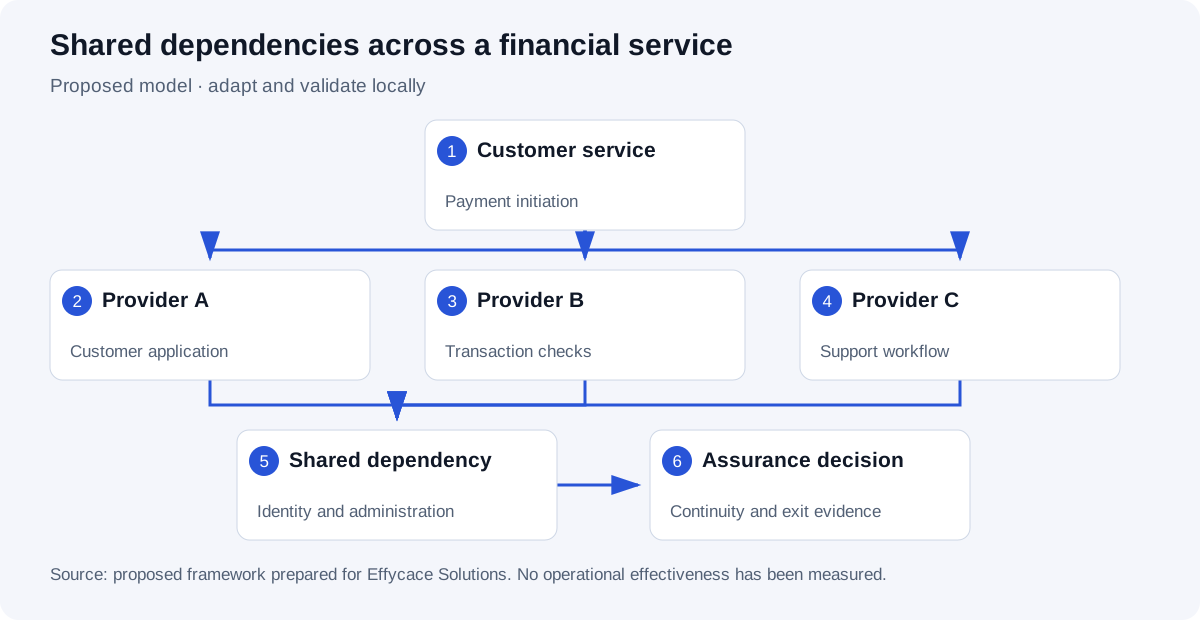
Source: proposed model prepared for Effycace Solutions. This diagram represents analytical relationships and proposed workflow, not observations or measured effectiveness. A textual description is embedded in the downloadable SVG.
Framework component 2
Tier by consequences and uncertainty
Proposed · requires local validation
A proposed triage considers service disruption, information exposure, privileged access and substitutability. These dimensions should remain visible individually. Averaging them can hide a severe issue behind several low values.
For example, a provider with broad administrative access should receive a focused review of that access even if its contract value is small. A specialised processing provider may justify a detailed continuity review even if it does not store customer records. Neither conclusion requires a claim that the provider is generally insecure.
Assign an assessment depth after discussing the relationship with its owner. For a bounded low-consequence service, a limited evidence review may be appropriate. For a service with material disruption or data consequences, require deeper examination of architecture, rights and recovery. Add an explicit uncertainty marker when material facts are missing.
This triage is a proposed resource-allocation method. It does not define MAS materiality, regulatory outsourcing classification or a prescribed risk appetite. Those classifications need their own documented basis and can influence the assessment depth without being replaced by it.
Framework component 3
Convert assurances into testable claims
Proposed · requires local validation
The assessor should identify the claims on which approval depends. “The supplier has good security” is too broad to verify. “Administrative access to the production tenant requires an individually attributable identity and approved privilege” is specific enough to examine.
For each material claim, record the evidence and the boundary of what it establishes:
| Claim | Evidence to request or produce | Limitation to examine |
|---|---|---|
| Access is restricted | Role configuration, account sample and approval trail | Shared identities or support exceptions |
| Data can be recovered | Relevant recovery record or an authorised joint test | Different tenant, volume or failure scenario |
| Institution data can be transferred | Sample export, schema and controlled import result | Missing configuration, history or attachments |
| Incidents will be escalated | Contact path, contractual process and exercise record | Unavailable contacts or unclear event thresholds |
| Subcontractor changes are visible | Agreed notification mechanism and current dependency statement | Unidentified upstream dependencies |
Independent assurance reports can be useful evidence, but their scope and period matter. Review the service covered, exclusions, exceptions and responsibilities assigned to the customer. When an assessor relies on a provider's statement without verification, preserve that distinction in the decision record.
Evidence freshness should follow the claim. A signed contractual right may remain current until amendment; a privileged-account sample may become outdated after an operational change. Give important claims review triggers and owners, rather than applying an identical expiry date to every document.
Framework component 4
Connect contracting to operational capability
Proposed · requires local validation
Contract review should translate important risk questions into provisions that the institution and supplier can actually perform. Relevant subjects can include security responsibilities, incident communications, evidence access, subcontracting, data return, assistance on termination and handling retained copies. Appropriate wording and enforceability require contractual review for the specific arrangement.
An operational walkthrough should accompany material provisions. If the contract provides for data return, establish who requests it, how identity is verified, which format is supplied and what the institution needs to use it. If cooperation during an incident is promised, identify the coordination route and any prerequisites for sharing evidence.
Keep a record of unmet needs. A provider may offer a standard service whose terms cannot support a desired control. The institution then needs to decide whether it can reduce the exposure itself, choose another arrangement or accept the gap. Marking the contract review as complete should not make the unresolved dependency disappear.
Framework component 5
Test continuity and concentration by failure mode
Proposed · requires local validation
Select scenarios that challenge different dependencies: service unavailability, compromised provider administration, corrupted data, inability to contact essential support and abrupt termination. For each, describe how the institution would maintain or restore the business outcome.
Check whether the proposed alternative shares the dependency that caused the failure. A second environment can still rely on the same identity platform or deployment pipeline. Another provider might rely on the same upstream service. Where the institution cannot establish independence, record uncertainty rather than assuming diversity.
Treat manual alternatives as operating processes that need staffing, capacity and reconciliation. A procedure that works for a small test batch might not handle an extended outage. Include the time required to detect disruption, decide to switch and clear accumulated work after restoration.
Concentration does not automatically make an arrangement unacceptable. The institution may reasonably prefer a strong integrated provider to a fragmented design it cannot operate well. The acceptance should explain the tradeoff and the controls relied upon. A blanket instruction to diversify can create cost without establishing better service resilience.
Framework component 6
Make exit readiness observable
Proposed · requires local validation
Describe at least the planned end of a relationship and an accelerated exit under stress. Their destination, timing and provider cooperation assumptions may differ. If a rapid full exit is impractical, identify the interim operating state and its constraints.
An exit package should address the information and capabilities needed to move: data, schemas, configuration, interfaces, administrative rights, keys where transferable, licences and relevant operating knowledge. Identify elements that cannot move and the work required to replace them.
Verification can proceed in stages. A document review establishes the stated process. A controlled export demonstrates that data can be obtained. A target import examines usability. A bounded service exercise examines whether the institution can operate the result. Describe these stages separately; success at one does not prove the next.
The exit decision should account for transaction state and records reconciliation. A technically successful transfer can leave duplicate instructions, missing history or conflicting status. Assign ownership for the business checks that determine when the new arrangement can be trusted.
Framework component 7
Give decisions explicit gates
Proposed · requires local validation
The proposed model uses five decision points. These are internal management gates, not regulatory categories.
| Gate | Required decision | Minimum record |
|---|---|---|
| Select | Is this arrangement suitable for the intended service? | Consequences, assessment depth and material unknowns |
| Activate | Are controls and responsibilities ready for actual use? | Evidence, conditions and named acceptance |
| Change | Does a service, access or dependency change alter the decision? | Change impact and additional assurance needed |
| Renew | Does continued use remain justified? | Current evidence and unresolved obligations |
| Exit | Can the transition or termination proceed safely? | Transfer, reconciliation and closure conditions |
A conditional approval should specify the operating boundary. For example, a pilot using synthetic information with restricted access is different from full production use. Record the condition in a place that the operational team can enforce, with a date for reassessment.
Framework component 8
Assign decision rights
Proposed · requires local validation
The business owner accepts the service consequences within delegated authority. Technology validates implementation and dependency claims. Security assesses cyber controls and evidence limitations. Procurement maintains commercial coordination. Compliance and legal assess applicable obligations and contractual issues. An independent risk function challenges decisions where the institution's governance requires it.
Roles may be combined in a smaller institution, but responsibilities should remain explicit. The same individual should understand when they are providing technical evidence and when they are accepting business consequences. Escalation is needed when the proposed acceptance exceeds their authority.
Keep the acceptance short enough to read. State the exposure, evidence, remaining gap, rationale, boundary, owner and review trigger. Supporting documents can be linked. A large evidence folder without a clear decision does not establish accountability.
Framework component 9
Monitor changes that can invalidate approval
Proposed · requires local validation
Monitoring should target changes in the relationship's assumptions. Examples include expanded access, a new deployment region, a critical subcontractor change, a material incident or a failed recovery exercise. Require the relationship owner to route relevant changes to the appropriate technical and risk reviewers.
Use metrics with clear denominators. “Critical service relationships with a current decision record” requires a defined inventory. “Overdue material evidence gaps” requires a documented definition of materiality and a target date. Distinguish an open investigation from a confirmed control failure.
The following proposed dashboard supports management discussion:
| Indicator | Decision it informs |
|---|---|
| Material relationships without confirmed service ownership | Whether accountability work must precede assessment expansion |
| Important claims supported only by supplier assertion | Where additional verification may change risk acceptance |
| Accepted gaps past their review date | Which decisions require renewal or escalation |
| Continuity and exit exercises completed, with scope | What capability has actually been demonstrated |
| Shared dependencies affecting several critical services | Where a combined disruption scenario merits investment |
Do not convert these indicators into a claimed breach probability or a universal institution ranking. Their value lies in directing attention to decisions and evidence gaps.
Framework component 10
A practical implementation sequence
Proposed · requires local validation
In the first 30 days, select one service and reconcile its procurement, technology and risk records. Agree ownership and the definition of minimum acceptable delivery. Confirm the regulatory scope through the institution's established process.
In days 31–60, identify the few claims that determine whether continued use is acceptable. Review existing evidence before requesting more. Walk through incident escalation and data retrieval with the supplier, and document shared dependencies.
In days 61–90, execute one bounded assurance exercise. It might test recovery access or a sample data export and import. Obtain written findings from the responsible internal teams, record limits and present treatment options to the decision owner.
In the following quarter, refine the templates using the pilot and expand to the next group of relationships. Estimate the review effort per relationship before setting coverage targets. A smaller evidence-based programme is more actionable than a large register of unsupported green ratings.
Framework component 11
Worked decision example
Proposed · requires local validation
A hypothetical fintech uses a hosted case-management platform for payment investigations. It can tolerate limited disruption, but outstanding cases must retain their history and supporting documents. The provider offers a periodic data export, and the institution initially treats that as adequate exit assurance.
A controlled import trial finds that the export contains case fields but excludes some attachments and workflow state. This is a hypothetical result, not an observed provider finding. The decision changes: data return exists, but it is not yet a usable replacement service.
Management can request an expanded export, maintain an approved independent archive, redesign the workflow or accept a defined transition limitation. The assurance record should describe the remaining exposure and who will validate the selected treatment. The exercise earns its value by changing a specific decision.
Framework component 12
A reusable assurance decision record
Proposed · requires local validation
The following proposed template can be completed after a review. It should be short enough for the acceptance owner to understand without reconstructing the assessment from its attachments.
Service and arrangement: Identify the customer or internal outcome, relevant legal entity, provider and technical scope. State whether the review covers current use, a proposed expansion or a transition.
Decision required: Describe the choice in concrete terms, including the proposed operating boundary. A request to continue a limited pilot is different from approval to process production customer information.
Claims relied upon: List the few claims essential to acceptance and link each to evidence. For each claim, record what was demonstrated, what came only from provider assertion and what remains untested.
Failure scenario: Name the scenario used to examine continuity or exit. Describe the alternative operation, its dependencies and its known capacity limits. Identify any assumption that would invalidate the proposed treatment.
Residual gap: Explain the remaining exposure in business terms. State whether the gap is a confirmed weakness, missing evidence or an architectural limitation. Those conditions may require different responses.
Acceptance and follow-up: Name the decision owner, rationale, conditions, action owners and review triggers. Include the next review date and the event that would require an earlier reassessment.
This template should not become a second inventory. Link established records and keep the decision itself current. When an important fact changes, update the acceptance rather than merely adding another document to the evidence folder.
Framework component 13
Use findings to compare investment options
Proposed · requires local validation
An assurance review is most useful when it supports a choice. If a service depends on one difficult-to-replace provider, management may consider strengthening recovery, reducing the scope of dependence, preparing a staged transition or retaining the arrangement with additional oversight.
Compare options against the same scenario and service objective. Estimate implementation effort, ongoing operational burden, dependencies introduced and the evidence that would establish success. Do not claim a numerical reduction in risk unless the institution has an appropriate analytical basis.
For example, a hypothetical institution might choose between maintaining an independent archive and building a replacement processing platform. The archive could improve access to records without restoring transaction capability. The platform could address a wider service need but require substantial integration and staffing. The options solve different problems; their cost should be assessed against the specific outcome management needs.
Set an acceptance test before funding the change. If the intended outcome is usable records during supplier loss, define the retrieval and validation exercise. If it is service continuation, test the actual operating path and reconciliation. This makes the subsequent review about demonstrated capability rather than completion of procurement.
5Implementation and validation
Recommendations are ordered by priority. Effort is a broad estimate for a mid-sized organisation; your own will depend on what is already in place.
| # | Recommendation | Owner | Priority | Effort | Framework reference |
|---|---|---|---|---|---|
| 1 | Map one critical service through its shared technical and operational dependencies. | Business owner with technology | High | Medium | FSB toolkit §3.5, §3.8 |
| 2 | Separate continuity readiness from planned and accelerated exit. | Operational resilience lead | High | Medium | FSB toolkit §3.6–3.7 |
| 3 | Verify a material recovery or data-transfer claim in a controlled exercise. | Technology owner | High | Medium | FSB toolkit §3.6–3.7 |
| 4 | Record the residual dependency and accept or fund treatment through the appropriate risk forum. | Business risk owner | Medium | Low | MAS third-party resource overview |
In the first 30 days, select one service and reconcile its procurement, technology and risk records. Agree ownership and the definition of minimum acceptable delivery. Confirm the regulatory scope through the institution's established process.
In days 31–60, identify the few claims that determine whether continued use is acceptable. Review existing evidence before requesting more. Walk through incident escalation and data retrieval with the supplier, and document shared dependencies.
In days 61–90, execute one bounded assurance exercise. It might test recovery access or a sample data export and import. Obtain written findings from the responsible internal teams, record limits and present treatment options to the decision owner.
In the following quarter, refine the templates using the pilot and expand to the next group of relationships. Estimate the review effort per relationship before setting coverage targets. A smaller evidence-based programme is more actionable than a large register of unsupported green ratings.
| Action | Completion evidence |
|---|---|
| Map one critical service through its shared technical and operational dependencies. | Validated map; material unknowns have owners. |
| Separate continuity readiness from planned and accelerated exit. | Distinct scenario, capacity and dependency records. |
| Verify a material recovery or data-transfer claim in a controlled exercise. | Exercise record with observed result and limits. |
| Record the residual dependency and accept or fund treatment through the appropriate risk forum. | Decision, action owner and review trigger recorded. |
Download the assessment worksheet (CSV) · Download the framework diagram (SVG) · Download the source register (JSON)
Companion report: When a critical technology provider fails: assessing concentration and exit readiness.
6Limitations
- This whitepaper is a qualitative synthesis of the three primary sources cited in section 1, accompanied by original proposed templates and operating practices. No contracts, client systems or supplier controls were inspected. No effectiveness, cost-saving or comparative maturity claim is made. The worked example is hypothetical, and the framework requires institutional validation before broad adoption.
- Confidence in a particular institution's readiness cannot be established without reviewing its environment. Regulatory applicability remains specific to the institution and must be checked before operational use.
- The framework has not been independently peer reviewed or empirically validated. Regulatory references reflect sources checked on 11 November 2026 and may change; readers must determine current applicability.
7How to use this whitepaper
Design principles are proposed practices, not measured findings. Confidence concerns the support for an analytical judgement, not a numerical probability of an incident. No likelihood estimates are made. Hypothetical examples and conceptual diagrams do not establish prevalence or effectiveness. References describe source guidance; worksheets and implementation steps are proposed tools.
- High confidence
- Based on good-quality information from several independent sources, or on a complete dataset. A high-confidence judgement can still be wrong.
- Moderate confidence
- Based on credible information, but with gaps, a limited sample or more than one plausible interpretation.
- Low confidence
- Based on scarce, fragmented or single-source information. Treat it as something to watch, not as the sole basis for a major decision.
8References
- MAS. Third-Party Risk Management. Resource page reviewed 11 November 2026. https://www.mas.gov.sg/regulation/third-party-risk-management
- Financial Stability Board. (2023). Enhancing Third-Party Risk Management and Oversight: A toolkit for financial institutions and financial authorities. Final, 4 December 2023. https://www.fsb.org/uploads/P041223-1.pdf
- Federal Reserve, FDIC and OCC. (2023). Agencies issue final guidance on third-party risk management. 6 June 2023. https://www.federalreserve.gov/newsevents/pressreleases/bcreg20230606a.htm
9About this whitepaper
- Author
- Fahad Imran, Effycace Solutions
- Funding and interests
- Published by Effycace Solutions with Fahad Imran as author. Prepared using AI-assisted research and drafting from the cited public sources. No client information was used. No independent peer review or operational evaluation was conducted.
- Distribution
- TLP:CLEAR This report may be shared freely, with attribution.
- Corrections
- If you find an error, write to contact@effycace.com. Corrections are recorded in the version history below.
How to cite
Fahad Imran (2026). An evidence-based framework for third-party cyber risk (Report EFF-WP-2026-001, version 1.0). Effycace Solutions Pte Ltd. https://www.effycace.com/research/reports/third-party-cyber-risk-financial-institutions-whitepaper/
Version history
| Version | Date | Change |
|---|---|---|
| 0.9 | 11 November 2026 | Integrated editorial draft with source register, conceptual diagram and assessment worksheet. Not published. |
| 1.0 | 12 November 2026 | First publication edition, with author attribution, explicit review limitations and supporting assessment materials. |
This report is general information, not advice for your specific circumstances. See our Terms of Use.