Research report · Financial services and fintech
When a critical technology provider fails: assessing concentration and exit readiness
A source-based analysis of shared dependencies, continuity assumptions and workable exit options for financial institutions.
Companion whitepaperAn evidence-based framework for third-party cyber risk EFF-WP-2026-001
Research cut-off: 11 November 2026 · Source-based analysis; no original empirical study.
1Executive summary
A financial institution can contract with several providers while remaining dependent on one underlying platform, identity service or operational team. The supplier list shows commercial relationships. It does not, by itself, show which failures would stop the institution serving customers.
This report proposes a service-based review of concentration and exit risk. Start with a customer outcome, trace the dependencies needed to deliver it, and test the assumptions behind continuity and replacement. Treat unknown dependencies as unresolved questions with owners. Distinguish an alternative provider that could eventually be procured from an alternative service that can operate within the business's disruption tolerance.
The principal recommendation is to examine one critical service end to end before expanding the review across the institution. The result should be a decision record explaining what could fail together, how long continuity options would work, what exit would require and which residual risks management accepts.
Key findings
Commercial diversity does not establish operational independence.
Continuity and exit need separate readiness evidence.
Assurance claims need evidence with a stated scope.
What this means
- Leadership
- Select one critical service and resolve the dependency or exit question that most affects risk acceptance.
- Security and technology
- Validate material technical assumptions, preserve evidence and state the boundaries of what was examined.
- Service and operational owners
- Own acceptance criteria, unresolved work and the review of changes that could invalidate an earlier decision.
2Scope and questions
Research questions
- How can an institution establish whether its supplier arrangements create an unacceptable dependency, even when individual providers have passed due diligence?
- Which claims are supported by the reviewed sources, and which proposed practices require local validation?
In scope
- Financial services and fintech service and security decisions, with a Singapore-focused editorial lens.
- Purposively selected official primary sources checked on 11 November 2026.
- Qualitative analysis, hypothetical examples and proposed assessment practices.
Out of scope
- Incident prevalence, statistical estimates of risk and regional attack rates.
- Client assessments, laboratory evaluation and measured control effectiveness.
- A complete legal or regulatory compliance determination.
3Methodology
This is a purposive review of the primary sources listed below, selected for direct relevance to the research question and authoritative provenance. It is not a systematic literature review; no completeness or exhaustive search claim is made.
Source guidance was compared with the decision questions in this publication. Analytical conclusions and proposed practices were developed separately from source descriptions. Examples are hypothetical. No interviews, client records, clinical workflows, production equipment or supplier controls were examined.
MAS states that third-party services should be subject to adequate governance and sound risk management. Its resource page separates bank and non-bank materials and links technology risk and business continuity considerations. Institutions must identify the instruments applicable to their own activities; the existence of a general third-party relationship does not establish that every outsourcing provision applies. MAS: Third-Party Risk Management.
The Financial Stability Board's final December 2023 toolkit addresses critical services, provider supply chains, business continuity, exit and concentration. It recognises that concentration can have benefits as well as risks and does not prescribe one universal concentration measure. The toolkit is international guidance, not Singapore legislation. FSB: Third-Party Risk Management and Oversight, sections 3.5–3.8.
For a comparative perspective, US banking agencies describe third-party risk management across planning, selection, contracting, monitoring and termination. This reinforces the lifecycle perspective; it should not be presented as a Singapore requirement. Federal Reserve: Final third-party risk management guidance.
Our interpretation is that continuity and exit assumptions deserve the same attention as onboarding evidence. Approval at contract signature cannot establish that the dependency remains acceptable after a service, integration or business model changes.
Sources
| Source | How it was used | Reliability |
|---|---|---|
| MAS. Third-Party Risk Management. Resource page reviewed 11 November 2026. | Singapore governance context; distinct bank and non-bank resources. | Official primary resource page; applicability requires institution-specific assessment. |
| Financial Stability Board. (2023). Enhancing Third-Party Risk Management and Oversight: A toolkit for financial institutions and financial authorities. Final, 4 December 2023. | Critical services, supply-chain dependencies, continuity, exit and concentration; sections 3.5–3.8. | Primary international guidance; not binding Singapore legislation. |
| Federal Reserve, FDIC and OCC. (2023). Agencies issue final guidance on third-party risk management. 6 June 2023. | Comparative lifecycle perspective. | Official announcement; US context only; full legal mapping not performed. |
Review
Prepared with AI-assisted research and drafting. Source references, content structure, internal links and build behaviour were checked during preparation. No independent subject-matter, clinical, engineering or legal peer review has been conducted.
- Preparation checks: Automated and AI-assisted checks, Source-link, content-structure and build verification; not independent peer review
Data availability
Download the assessment worksheet (CSV) · Download the framework diagram (SVG) · Download the source register (JSON)
Companion whitepaper: An evidence-based framework for third-party cyber risk.
4Analytical findings
Finding 1
Commercial diversity does not establish operational independence
Moderate confidence
Analytical basis: reference 1, reference 2, reference 3. The discussion below is qualitative interpretation and proposed assessment practice, not a measured prevalence finding.
Why supplier counts can mislead
Consider a hypothetical institution offering digital payments. Its customer application, transaction monitoring and support platform come from three suppliers. The procurement register records three independent contracts. A service review discovers that all three depend on the same identity tenant for administration and incident coordination.
The institution also has a recovery environment in another geographic region. That arrangement may help with a regional outage, but it does not establish independence from compromised administrative identities or a shared configuration error. The relevant question is the failure scenario against which the alternative was designed.
This example illustrates a distinction between commercial diversity and operational independence. It does not establish that multiple providers are always preferable. A second platform introduces its own integration, staffing and reconciliation demands. The decision should compare actual recovery options and their costs, including the operational complexity the institution can sustain.
Map the service before judging the provider
Select a service with an accountable business owner and a defined outcome: accepting a payment instruction, processing a withdrawal or providing access to customer records. Specify what minimum acceptable delivery means during disruption. Avoid describing the service only as a software product.
Record dependencies at a level that supports decisions. The mapping exercise should answer the following questions:
| Dependency | Question to resolve | Useful evidence |
|---|---|---|
| Applications and data | What must be available, current and trustworthy? | Architecture and tested data recovery path |
| Identity and administration | Who can operate recovery if normal access is unavailable? | Access walkthrough and recovery-account test |
| Infrastructure and connectivity | Which shared services could disable several applications? | Validated deployment and network dependency map |
| Provider operations | Which personnel and subcontractors are needed during disruption? | Agreed escalation arrangements and dependency disclosures |
| Customer and transaction processes | What happens to instructions received during an outage? | Tested queue, reconciliation and communication procedures |
Completeness is a working objective, not a reason to delay every decision until the map is perfect. Mark each dependency as confirmed, partly confirmed or unknown. Give material unknowns an investigation date and escalation route. A diagram with unlabelled uncertainty can create more confidence than the evidence supports.
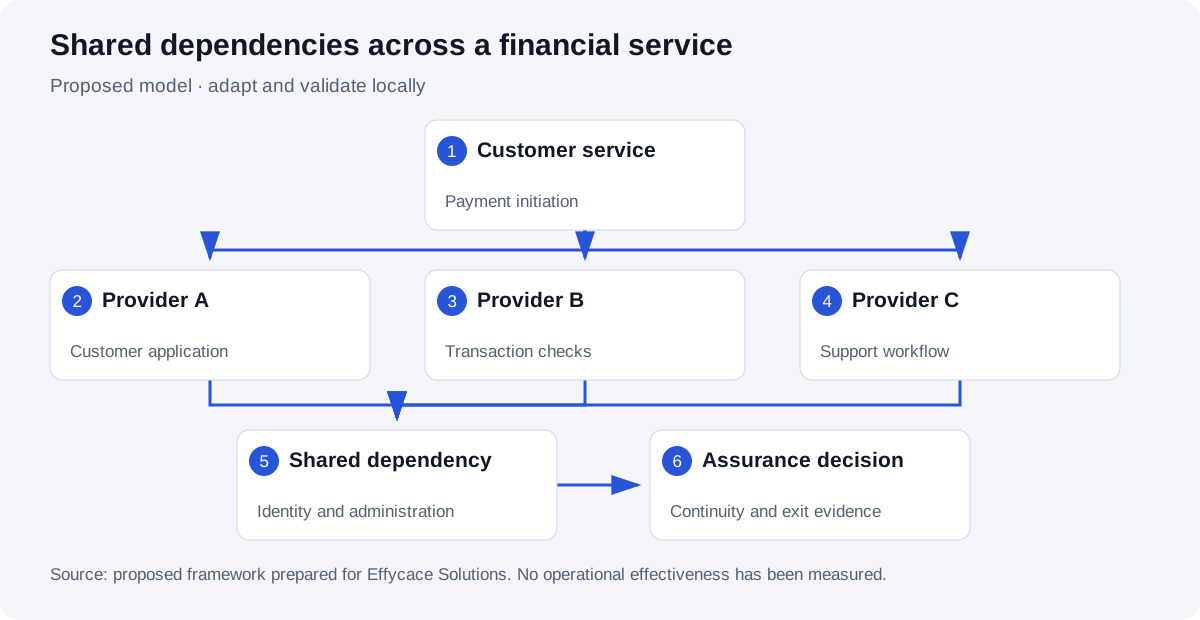
Source: proposed model prepared for Effycace Solutions. This diagram represents analytical relationships and proposed workflow, not observations or measured effectiveness. A textual description is embedded in the downloadable SVG.
Finding 2
Continuity and exit need separate readiness evidence
Moderate confidence
Analytical basis: reference 1, reference 2, reference 3. The discussion below is qualitative interpretation and proposed assessment practice, not a measured prevalence finding.
Distinguish continuity from exit
Continuity keeps a service operating or restores it after disruption. Exit transfers or ends the relationship. Their time horizons and prerequisites may differ substantially.
For the hypothetical payments service, an alternate processing route might support a limited subset of transactions during an outage. Moving the complete customer history to a replacement platform could require transformation, testing and commercial negotiation. Calling both arrangements “the exit plan” obscures what each can achieve.
Use separate readiness statements. A continuity statement should identify the scenario, activation authority, available capacity and duration. An exit statement should identify the target operating model, data export conditions, migration dependencies, likely constraints and the evidence supporting feasibility. Where a replacement is unavailable within the desired period, record that limitation explicitly.
Examine concentration through scenarios
The following review sequence is proposed for internal use:
- Name the failure. Provider outage, supplier compromise, loss of administrative access and abrupt provider withdrawal are different scenarios.
- Identify simultaneous effects. Mark which services share the affected component or operational dependency.
- Test the alternative's independence. Check its identity, data, staffing, connectivity and configuration dependencies.
- Estimate the service consequence. Describe customer impact and operational workload without inventing precision the evidence cannot support.
- Choose a treatment. Options include stronger recovery, reduced coupling, a staged migration, a bounded manual process or explicit acceptance.
The exercise should include the provider where its actions are essential. An institution cannot establish a supplier's recovery performance by rehearsing only its own internal call tree. Conversely, supplier participation in a discussion is not proof that technical recovery works. Report what was actually demonstrated.
Finding 3
Assurance claims need evidence with a stated scope
Moderate confidence
Analytical basis: reference 1, reference 2, reference 3. The discussion below is qualitative interpretation and proposed assessment practice, not a measured prevalence finding.
Evidence that should change a decision
A stronger review replaces broad assurances with specific artefacts. A claim that data is portable becomes more useful when a sample export has been imported into a controlled target and checked. A claim that support is available becomes more useful when escalation contacts and access prerequisites have been exercised.
Evidence still needs scope. A successful sample migration does not establish that the full production dataset can move within the same period. A recovery test with every provider engineer present may not represent the staffing available during a widespread incident. Document those differences before using the result to justify acceptance.
The objective is proportional assurance. Low-consequence relationships need not receive the same investigation as a service whose failure would immediately interrupt customer access to funds. Resource allocation should follow consequences and uncertainty, with a review when either changes.
Questions for the risk committee
The committee should be able to establish which critical services could fail together, whether alternatives remain accessible under the chosen scenario, and what evidence supports restoration or transfer. It should also understand whether the institution is knowingly accepting a difficult-to-replace dependency and why that choice is reasonable.
Useful measures include critical services with reviewed dependency maps, material unknowns past their investigation date, and continuity assumptions validated through exercises. These are oversight indicators; none is a probability of institutional failure.
5Recommendations
Recommendations are ordered by priority. Effort is a broad estimate for a mid-sized organisation; your own will depend on what is already in place.
| # | Recommendation | Owner | Priority | Effort | Framework reference |
|---|---|---|---|---|---|
| 1 | Map one critical service through its shared technical and operational dependencies. | Business owner with technology | High | Medium | FSB toolkit §3.5, §3.8 |
| 2 | Separate continuity readiness from planned and accelerated exit. | Operational resilience lead | High | Medium | FSB toolkit §3.6–3.7 |
| 3 | Verify a material recovery or data-transfer claim in a controlled exercise. | Technology owner | High | Medium | FSB toolkit §3.6–3.7 |
| 4 | Record the residual dependency and accept or fund treatment through the appropriate risk forum. | Business risk owner | Medium | Low | MAS third-party resource overview |
During the first month, choose one critical service, identify its business and technology owners, and reconcile the contract register with the operational dependency map. Ask compliance to confirm the relevant regulatory scope separately from the technical assessment.
During the second month, examine one plausible shared failure and one provider exit scenario. Validate the most important assumptions with the provider. Select a bounded exercise that can test a material claim without risking live customer operations.
During the third month, present the findings to the appropriate risk forum. Show the service outcome at risk, the evidence collected, unresolved questions and the costed treatment options. Allocate owners and review dates rather than closing the review simply because a workshop occurred.
| Action | Completion evidence |
|---|---|
| Map one critical service through its shared technical and operational dependencies. | Validated map; material unknowns have owners. |
| Separate continuity readiness from planned and accelerated exit. | Distinct scenario, capacity and dependency records. |
| Verify a material recovery or data-transfer claim in a controlled exercise. | Exercise record with observed result and limits. |
| Record the residual dependency and accept or fund treatment through the appropriate risk forum. | Decision, action owner and review trigger recorded. |
Download the assessment worksheet (CSV) · Download the framework diagram (SVG) · Download the source register (JSON)
Companion whitepaper: An evidence-based framework for third-party cyber risk.
6Limitations
- No institution's provider landscape, contracts or recovery capability was assessed. Public guidance cannot establish the frequency of hidden concentration or the readiness of any particular provider.
- The framework has not been independently peer reviewed or empirically validated. Regulatory references reflect sources checked on 11 November 2026 and may change; readers must determine current applicability.
7How to read this report
Confidence is moderate in the qualitative analytical conclusions because primary guidance supports the broad themes while local applicability and implementation remain untested. Confidence concerns the support for an analytical judgement, not a numerical probability of an incident. No likelihood estimates are made. Hypothetical examples and conceptual diagrams do not establish prevalence or effectiveness. References describe source guidance; worksheets and implementation steps are proposed tools.
- High confidence
- Based on good-quality information from several independent sources, or on a complete dataset. A high-confidence judgement can still be wrong.
- Moderate confidence
- Based on credible information, but with gaps, a limited sample or more than one plausible interpretation.
- Low confidence
- Based on scarce, fragmented or single-source information. Treat it as something to watch, not as the sole basis for a major decision.
8References
- MAS. Third-Party Risk Management. Resource page reviewed 11 November 2026. https://www.mas.gov.sg/regulation/third-party-risk-management
- Financial Stability Board. (2023). Enhancing Third-Party Risk Management and Oversight: A toolkit for financial institutions and financial authorities. Final, 4 December 2023. https://www.fsb.org/uploads/P041223-1.pdf
- Federal Reserve, FDIC and OCC. (2023). Agencies issue final guidance on third-party risk management. 6 June 2023. https://www.federalreserve.gov/newsevents/pressreleases/bcreg20230606a.htm
9About this report
- Author
- Fahad Imran, Effycace Solutions
- Funding and interests
- Published by Effycace Solutions with Fahad Imran as author. Prepared using AI-assisted research and drafting from the cited public sources. No client information was used. No independent peer review or operational evaluation was conducted.
- Distribution
- TLP:CLEAR This report may be shared freely, with attribution.
- Corrections
- If you find an error, write to contact@effycace.com. Corrections are recorded in the version history below.
How to cite
Fahad Imran (2026). When a critical technology provider fails: assessing concentration and exit readiness (Report EFF-RR-2026-003, version 1.0). Effycace Solutions Pte Ltd. https://www.effycace.com/research/reports/financial-services-provider-concentration-exit-risk/
Version history
| Version | Date | Change |
|---|---|---|
| 0.9 | 11 November 2026 | Integrated editorial draft with source register, conceptual diagram and assessment worksheet. Not published. |
| 1.0 | 12 November 2026 | First publication edition, with author attribution, explicit review limitations and supporting assessment materials. |
This report is general information, not advice for your specific circumstances. See our Terms of Use.