Research report · Manufacturing and operational technology
Remote vendor access to production systems: where control needs verification
A source-based analysis of remote-support routes, task-specific authority, engineering acceptance and safe closure.
Companion whitepaperDesigning secure IT–OT access without disrupting production EFF-WP-2026-003
Research cut-off: 11 November 2026 · Source-based analysis; no original empirical study.
1Executive summary
Remote support can shorten maintenance delays and provide access to specialist expertise. Its risk depends on the complete route into the plant, the authority granted during a session and the ability to end access without creating an unsafe operating condition.
This report proposes examining remote support as a lifecycle: request, authorise, connect, perform work, verify the result and close access. A secure gateway is an important component, but the review should also cover alternate routes, shared target accounts, maintenance tools and local decision authority.
Manufacturers should start with one production area and establish the actual remote-access paths before attempting a broad technology rollout. The immediate output should be an approved connection register, a named operational owner and evidence that one representative support session can be constrained and closed as intended.
Key findings
The approved gateway does not establish visibility of every support route.
Access assurance must follow the task through to the target.
Control effectiveness depends on operational acceptance and safe closure.
What this means
- Leadership
- Assign plant ownership for one vendor support route and its safe operating conditions.
- Security and technology
- Validate material technical assumptions, preserve evidence and state the boundaries of what was examined.
- Service and operational owners
- Own acceptance criteria, unresolved work and the review of changes that could invalidate an earlier decision.
2Scope and questions
Research questions
- What should a manufacturer verify before accepting that vendor remote access is appropriately controlled?
- Which claims are supported by the reviewed sources, and which proposed practices require local validation?
In scope
- Manufacturing and operational technology service and security decisions, with a Singapore-focused editorial lens.
- Purposively selected official primary sources checked on 11 November 2026.
- Qualitative analysis, hypothetical examples and proposed assessment practices.
Out of scope
- Incident prevalence, statistical estimates of risk and regional attack rates.
- Client assessments, laboratory evaluation and measured control effectiveness.
- A complete legal or regulatory compliance determination.
3Methodology
This is a purposive review of the primary sources listed below, selected for direct relevance to the research question and authoritative provenance. It is not a systematic literature review; no completeness or exhaustive search claim is made.
Source guidance was compared with the decision questions in this publication. Analytical conclusions and proposed practices were developed separately from source descriptions. Examples are hypothetical. No interviews, client records, clinical workflows, production equipment or supplier controls were examined.
Singapore's OT Cybersecurity Masterplan 2024 promotes secure deployment across the OT lifecycle and addresses resilience beyond critical information infrastructure. It is a strategic reference; this paper does not treat the Masterplan as a universal set of mandatory controls for every manufacturer. CSA: OT Cybersecurity Masterplan 2024.
NIST SP 800-82 Rev. 3 recommends justified, bounded remote access that does not negate safety or security controls. Its discussion includes temporary access, monitoring and removal when no longer needed. NIST: Guide to OT Security, remote access discussion.
The UK NCSC's January 2026 connectivity guidance explains how centralising and standardising connections supports consistent control, including a managed remote-access route through a demilitarised zone. NCSC: Secure connectivity, Principle 3.
CISA's May 2025 OT mitigation factsheet recommends securing essential remote access, applying least privilege and segmenting IT and OT. CISA: Primary mitigations for OT.
Our interpretation is that assurance should follow the maintenance activity all the way to its target. Reviewing authentication at the boundary leaves unanswered what the user can reach, change or leave running afterwards.
Sources
| Source | How it was used | Reliability |
|---|---|---|
| Cyber Security Agency of Singapore. (2024). Singapore’s Operational Technology Cybersecurity Masterplan 2024. | Singapore strategic context and secure deployment across the OT lifecycle. | Official overview; a strategy, not a universal mandatory control checklist. |
| Stouffer et al. (2023). Guide to Operational Technology (OT) Security. NIST SP 800-82 Rev. 3. | Bounded remote access and disconnect capabilities compatible with OT operations. | Primary technical guidance; relevant remote-access provisions reviewed. |
| UK National Cyber Security Centre. (2026). Secure connectivity principles for OT: Principle 3, Centralise and standardise network connections. | Repeatable managed access architecture and OT boundary pattern. | Primary technical guidance; effectiveness depends on local implementation. |
| CISA and partners. (2025). Primary Mitigations to Reduce Cyber Threats to Operational Technology. 6 May 2025. | Essential remote access, least privilege and IT–OT segmentation. | Official-source indexed text reviewed; direct retrieval returned HTTP 403; used only for visible recommendations. |
Review
Prepared with AI-assisted research and drafting. Source references, content structure, internal links and build behaviour were checked during preparation. No independent subject-matter, clinical, engineering or legal peer review has been conducted.
- Preparation checks: Automated and AI-assisted checks, Source-link, content-structure and build verification; not independent peer review
Data availability
Download the assessment worksheet (CSV) · Download the framework diagram (SVG) · Download the source register (JSON)
Companion whitepaper: Designing secure IT–OT access without disrupting production.
4Analytical findings
Finding 1
The approved gateway does not establish visibility of every support route
Moderate confidence
Analytical basis: reference 1, reference 2, reference 3, reference 4. The discussion below is qualitative interpretation and proposed assessment practice, not a measured prevalence finding.
The route may be wider than the approved diagram
Consider a hypothetical packaging plant. Its approved support route uses a managed gateway with individually authenticated vendor access. An equipment supplier also maintains a cellular support device installed during commissioning. The cellular route is missing from the central register and follows a different access process.
The gateway may be operating as intended, but it does not establish control over the second route. The issue is incomplete visibility and ownership, rather than evidence that the gateway itself has failed. Removing the unregistered route also requires care: it may support a legitimate operational function whose replacement must be planned.
This illustrates why discovery should combine engineering records, supplier discussions and authorised technical evidence. A review that relies only on the enterprise VPN inventory may miss other means of connectivity. Equally, absence from a document does not prove that a route is malicious or exploitable.
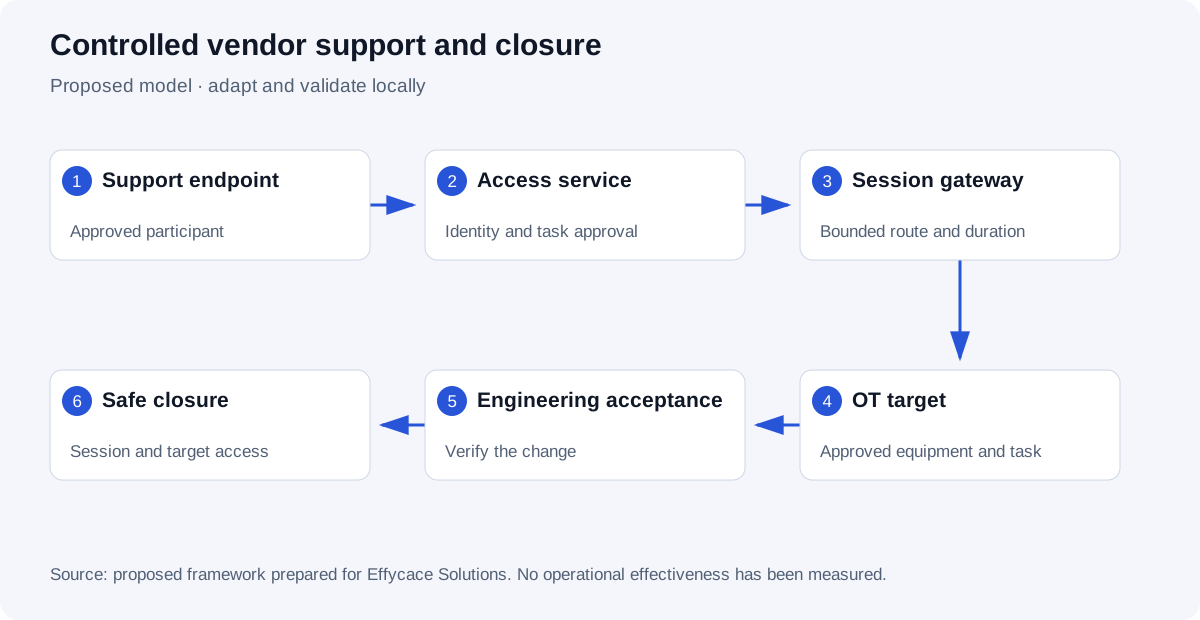
Source: proposed model prepared for Effycace Solutions. This diagram represents analytical relationships and proposed workflow, not observations or measured effectiveness. A textual description is embedded in the downloadable SVG.
Finding 2
Access assurance must follow the task through to the target
Moderate confidence
Analytical basis: reference 1, reference 2, reference 3, reference 4. The discussion below is qualitative interpretation and proposed assessment practice, not a measured prevalence finding.
Review the session lifecycle
The proposed assessment asks for evidence at six stages:
| Stage | Question | Evidence to examine |
|---|---|---|
| Request | What work is needed, on which equipment and why remotely? | Maintenance request and asset scope |
| Authorise | Who confirms timing and operational conditions? | Plant approval and defined work window |
| Connect | Which person, device and route are permitted? | Identity, connection path and target restrictions |
| Perform | What actions and file transfers are allowed? | Access profile, work plan and relevant logs |
| Verify | Did the work produce the approved result? | Engineering checks and change record |
| Close | Are session, credentials and exceptions appropriately ended? | Termination and access-removal evidence |
An approval should be specific enough to distinguish diagnosis from a configuration or logic change. The permissions and oversight appropriate for viewing telemetry may not be appropriate for changing how equipment operates. Engineering should define the distinction for its systems.
Three gaps worth investigating first
An authenticated user with an overbroad destination. Strong authentication establishes who may enter a route. It does not establish that the route is restricted to the equipment required for the task. Examine network and application scope together, including whether access to an engineering workstation enables further connections.
A temporary intervention with persistent authority. A time-bounded gateway account can leave behind a service account, remote tool or enabled target login. Session closure should check the access created or changed during the work, as well as the original connection.
A vendor action without local operational acceptance. The vendor may complete its technical task while the plant still needs to verify the resulting process state. The maintenance record should identify who accepts the work and which checks are required before ordinary production continues.
These are proposed investigation themes, not prevalence findings. Their significance depends on the plant architecture, equipment and operating conditions.
Finding 3
Control effectiveness depends on operational acceptance and safe closure
Moderate confidence
Analytical basis: reference 1, reference 2, reference 3, reference 4. The discussion below is qualitative interpretation and proposed assessment practice, not a measured prevalence finding.
Keep safety and availability in the decision
A cyber control can affect maintenance and production if it is introduced without understanding the system. The assessment should therefore involve the operational owner and appropriate engineering specialists before changing connectivity, timeout behaviour or access privileges.
The same care applies to ending a session. Disabling remote access should be planned and tested so that it does not unpredictably interrupt a required process or leave a change incomplete. Define who can initiate isolation, what the expected consequence is and when an operational response is needed.
This is not a reason to keep unrestricted access indefinitely. It is a reason to make the migration and exception process explicit. A temporary exception needs a named owner, documented constraints and a realistic review or removal plan.
Collect evidence proportionately
Begin with existing network diagrams, equipment inventories, maintenance records and supplier contracts. Walk through the route with plant and vendor representatives. Review authorised configuration and logs where available. Validate the resulting map through methods approved for the environment.
Avoid treating an active scan of production equipment as a routine first step. Where testing might affect availability or safety, use a lab, controlled maintenance window or a narrower method under an approved plan. State what could and could not be verified.
Prioritise routes with broad authority, unclear ownership or uncertain operational consequences. A connection used rarely can still matter if it provides significant reach. Connection count alone is not a useful measure of exposure.
Demonstrate one complete support session
Select a representative, low-risk activity with the plant owner. In an appropriate test setting or authorised maintenance window, demonstrate that the approved person can reach the intended target and that access outside the approved scope is constrained using safe verification methods.
Confirm that operations can identify the active session and contact the responsible participants. Test the agreed ending process, including time expiry where applicable and any target-side access changes. Examine the evidence afterwards to establish whether the session can be connected to a named person, task and acceptance record.
The exercise should report its boundaries. A test of one vendor and protocol does not establish all vendor routes are controlled. A log showing connection start and end does not prove that every command was recorded. Avoid claiming more visibility than the system provides.
5Recommendations
Recommendations are ordered by priority. Effort is a broad estimate for a mid-sized organisation; your own will depend on what is already in place.
| # | Recommendation | Owner | Priority | Effort | Framework reference |
|---|---|---|---|---|---|
| 1 | Register all remote support routes for one production area, including alternate connectivity. | OT engineering owner | High | Medium | CSA OT Masterplan; NCSC connectivity Principle 3 |
| 2 | Bind each support approval to a person, task, target and work window. | Maintenance lead with security | High | Medium | NIST SP 800-82r3 remote-access guidance |
| 3 | Validate the normal and emergency closure process with engineering oversight. | Plant owner | High | Medium | NIST SP 800-82r3 AC-17(9) discussion |
| 4 | Track legacy exceptions and retire redundant routes through controlled change. | OT architecture and supplier manager | Medium | Medium | NCSC connectivity Principle 3 |
In the first month, select one production area and build the connection register with engineering and supplier input. Assign operational ownership and document uncertainty, including alternate connectivity paths.
In the second month, agree a standard session process, an exception route and the operational conditions for isolation. Compare the intended controls with the capabilities of existing equipment and support arrangements. Plan changes through the site's maintenance and safety processes.
In the third month, demonstrate the approved route and closure process, then present findings to plant and security leadership. Prioritise remaining gaps by potential operational consequence and breadth of access. Set dates to reassess exceptions and expand the review to other production areas.
| Action | Completion evidence |
|---|---|
| Register all remote support routes for one production area, including alternate connectivity. | Route register with evidence dates and owners. |
| Bind each support approval to a person, task, target and work window. | Approved request and constrained route demonstrated. |
| Validate the normal and emergency closure process with engineering oversight. | Connection state and expected operational effects verified. |
| Track legacy exceptions and retire redundant routes through controlled change. | Exception review and documented retirement evidence. |
Download the assessment worksheet (CSV) · Download the framework diagram (SVG) · Download the source register (JSON)
Companion whitepaper: Designing secure IT–OT access without disrupting production.
6Limitations
- This desk research does not establish how common uncontrolled vendor access is, identify any manufacturer's exposure or compare commercial access products. The proposed workflow has not been trialled by Effycace. International guidance is used for practical reference and does not determine a Singapore manufacturer's legal obligations.
- Their effective implementation requires local evidence. The most useful next step is to trace and demonstrate one real support route from authorisation through safe closure, then use the findings to guide wider investment.
- The framework has not been independently peer reviewed or empirically validated. Regulatory references reflect sources checked on 11 November 2026 and may change; readers must determine current applicability.
7How to read this report
Confidence is moderate in the qualitative analytical conclusions because primary guidance supports the broad themes while local applicability and implementation remain untested. Confidence concerns the support for an analytical judgement, not a numerical probability of an incident. No likelihood estimates are made. Hypothetical examples and conceptual diagrams do not establish prevalence or effectiveness. References describe source guidance; worksheets and implementation steps are proposed tools.
- High confidence
- Based on good-quality information from several independent sources, or on a complete dataset. A high-confidence judgement can still be wrong.
- Moderate confidence
- Based on credible information, but with gaps, a limited sample or more than one plausible interpretation.
- Low confidence
- Based on scarce, fragmented or single-source information. Treat it as something to watch, not as the sole basis for a major decision.
8References
- Cyber Security Agency of Singapore. (2024). Singapore’s Operational Technology Cybersecurity Masterplan 2024. https://www.csa.gov.sg/resources/publications/singapore-s-operational-technology-cybersecurity-masterplan-2024/
- Stouffer et al. (2023). Guide to Operational Technology (OT) Security. NIST SP 800-82 Rev. 3. https://nvlpubs.nist.gov/nistpubs/SpecialPublications/NIST.SP.800-82r3.pdf
- UK National Cyber Security Centre. (2026). Secure connectivity principles for OT: Principle 3, Centralise and standardise network connections. https://www.ncsc.gov.uk/collection/operational-technology/secure-connectivity/principle-3
- CISA and partners. (2025). Primary Mitigations to Reduce Cyber Threats to Operational Technology. 6 May 2025. https://www.cisa.gov/sites/default/files/2025-05/fact-sheet-primary-mitigations-to-reduce-cyber-threats-to-operational-technology-508c.pdf
9About this report
- Author
- Fahad Imran, Effycace Solutions
- Funding and interests
- Published by Effycace Solutions with Fahad Imran as author. Prepared using AI-assisted research and drafting from the cited public sources. No client information was used. No independent peer review or operational evaluation was conducted.
- Distribution
- TLP:CLEAR This report may be shared freely, with attribution.
- Corrections
- If you find an error, write to contact@effycace.com. Corrections are recorded in the version history below.
How to cite
Fahad Imran (2026). Remote vendor access to production systems: where control needs verification (Report EFF-RR-2026-005, version 1.0). Effycace Solutions Pte Ltd. https://www.effycace.com/research/reports/manufacturing-ot-vendor-remote-access/
Version history
| Version | Date | Change |
|---|---|---|
| 0.9 | 11 November 2026 | Integrated editorial draft with source register, conceptual diagram and assessment worksheet. Not published. |
| 1.0 | 12 November 2026 | First publication edition, with author attribution, explicit review limitations and supporting assessment materials. |
This report is general information, not advice for your specific circumstances. See our Terms of Use.