Research report · Healthcare
Can patient services continue during a cyber incident?
A source-based examination of trusted information, downtime authority and recovery evidence for healthcare providers.
Companion whitepaperCyber resilience for clinics and healthcare groups EFF-WP-2026-002
Research cut-off: 11 November 2026 · Source-based analysis; no original empirical study.
1Executive summary
Healthcare cyber resilience should be assessed through the patient services an organisation can continue, the information staff can trust and the conditions under which systems can safely return. A restored server is useful evidence, but it does not establish that patient identification, results handling or treatment records are functioning correctly.
This report proposes a focused continuity review around one patient pathway. Identify its digital dependencies, agree a clinically governed downtime process and exercise the transition back to normal operations. Record service capacity, information limitations and unresolved work as part of the result.
The central decision belongs jointly to clinical and operational leadership: what can continue, under which constraints, and when must a service be limited or redirected? Technology teams provide evidence about systems and recovery. They should not be expected to determine the clinical acceptability of missing or uncertain information alone.
Key findings
Technical recovery alone does not establish patient-service continuity.
Information trust and service limits require clinical ownership.
Entering downtime and returning to normal both need examination.
What this means
- Leadership
- Sponsor a clinically governed review of one patient pathway and its approved downtime boundary.
- Security and technology
- Validate material technical assumptions, preserve evidence and state the boundaries of what was examined.
- Service and operational owners
- Own acceptance criteria, unresolved work and the review of changes that could invalidate an earlier decision.
2Scope and questions
Research questions
- What evidence should a healthcare provider request before accepting that a patient service can continue through a cyber disruption?
- Which claims are supported by the reviewed sources, and which proposed practices require local validation?
In scope
- Healthcare service and security decisions, with a Singapore-focused editorial lens.
- Purposively selected official primary sources checked on 11 November 2026.
- Qualitative analysis, hypothetical examples and proposed assessment practices.
Out of scope
- Incident prevalence, statistical estimates of risk and regional attack rates.
- Client assessments, laboratory evaluation and measured control effectiveness.
- A complete legal or regulatory compliance determination.
3Methodology
This is a purposive review of the primary sources listed below, selected for direct relevance to the research question and authoritative provenance. It is not a systematic literature review; no completeness or exhaustive search claim is made.
Source guidance was compared with the decision questions in this publication. Analytical conclusions and proposed practices were developed separately from source descriptions. Examples are hypothetical. No interviews, client records, clinical workflows, production equipment or supplier controls were examined.
Singapore's MOH Cybersecurity and Data Security Essentials address access management, essential-data backup and separation of backups from the operating environment. These are relevant foundations for resilience, but their presence alone does not demonstrate continuity of a complete patient pathway. MOH: CS/DS Essentials, sections A.5–A.9 and A.13–A.14.
The official HIA information page describes the security framework and explicitly states that HIA requirements have yet to take effect. This report therefore does not describe future HIA incident reporting provisions as already operative. Existing obligations and any later commencement must be assessed for the provider's circumstances. MOH: About Cybersecurity and Data Security.
For comparison, NHS England's standard for locally hosted infrastructure connects recovery arrangements with clinical and operational priorities and tested recovery objectives. It is used here as a practice reference, not as a requirement for Singapore providers. NHS England: Disaster recovery and business continuity.
Our interpretation is that assurance should follow the care workflow, including handoffs and reconciliation, rather than ending when the application becomes available.
Sources
| Source | How it was used | Reliability |
|---|---|---|
| Ministry of Health, Singapore. Cybersecurity and Data Security Essentials. Reviewed 11 November 2026. | Account control, health-information access and backup foundations. | Primary guidance; relevant sections reviewed; not a provider assessment. |
| Ministry of Health, Singapore. About Cybersecurity and Data Security. Reviewed 11 November 2026. | HIA framework and the page’s express statement that HIA requirements have yet to take effect. | Official page; commencement and applicability must be rechecked at publication. |
| NHS England. (2026). Disaster recovery and business continuity. Infrastructure hosting standards for the NHS. | Comparative connection between recovery objectives and clinical/operational risk. | Primary NHS standard for locally hosted infrastructure; not a Singapore requirement. |
Review
Prepared with AI-assisted research and drafting. Source references, content structure, internal links and build behaviour were checked during preparation. No independent subject-matter, clinical, engineering or legal peer review has been conducted.
- Preparation checks: Automated and AI-assisted checks, Source-link, content-structure and build verification; not independent peer review
Data availability
Download the assessment worksheet (CSV) · Download the framework diagram (SVG) · Download the source register (JSON)
Companion whitepaper: Cyber resilience for clinics and healthcare groups.
4Analytical findings
Finding 1
Technical recovery alone does not establish patient-service continuity
Moderate confidence
Analytical basis: reference 1, reference 2, reference 3. The discussion below is qualitative interpretation and proposed assessment practice, not a measured prevalence finding.
A patient pathway reveals dependencies a system list can miss
Consider a hypothetical outpatient clinic group. Its patient management application becomes unavailable, but telephone service remains operational. The clinic has paper forms and assumes it can continue its usual appointment load.
A walkthrough reveals additional dependencies: staff need a reliable way to match each person to the correct record, distinguish recent from older information, handle outstanding investigations and reconcile documents created during downtime. The forms provide a recording medium; they do not resolve these questions by themselves.
This example does not establish that paper workflows are unsafe. It shows why a fallback must be assessed as an operating process with staffing, information and handoff requirements. Its acceptable scope may be narrower than normal service, and that scope should be explicit before an incident.
Define what acceptable continuity means
Select one service such as outpatient registration through consultation and follow-up. The clinical lead should identify information or functions whose absence could change the service decision. Operations should identify staff, facilities and partner dependencies. Technology should describe availability and data-recovery options.
Distinguish system availability from information trust. A database may be accessible while some records are incomplete or under investigation. Conversely, a core application might be unavailable while a separately protected, approved information source remains usable. The appropriate clinical response depends on the information's scope, currency and reliability.
Record the approved operating boundary in language staff can apply. State which activities may proceed, who authorises exceptions, how uncertainty is escalated and when the service must be restricted. This report does not prescribe those clinical boundaries; it proposes how to make their ownership and evidence visible.
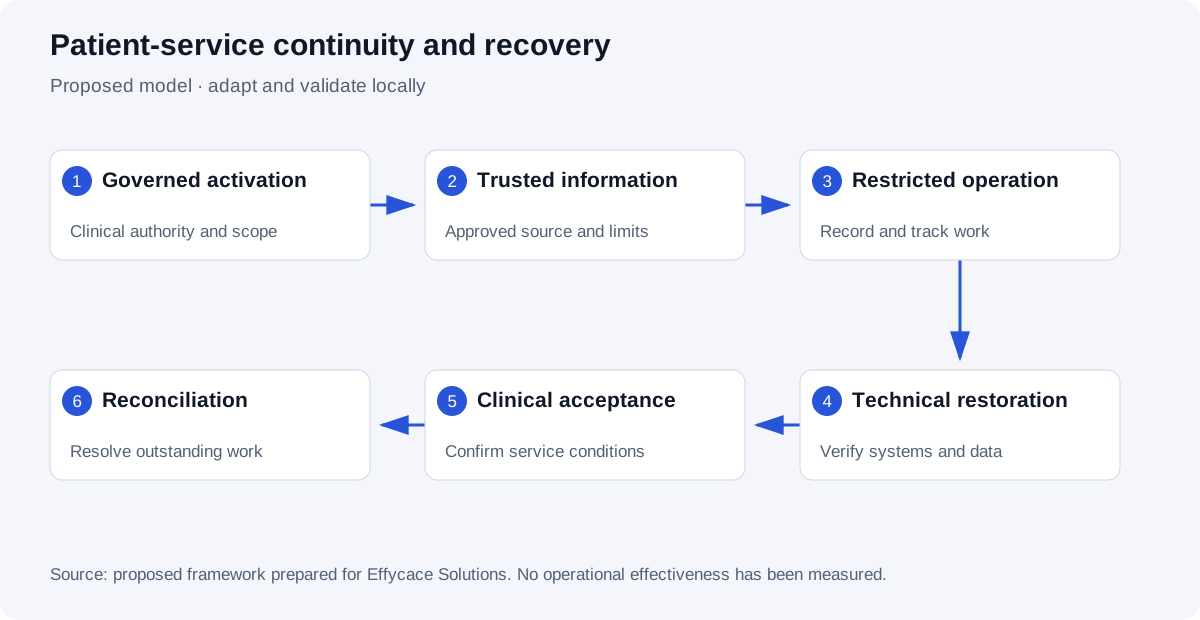
Source: proposed model prepared for Effycace Solutions. This diagram represents analytical relationships and proposed workflow, not observations or measured effectiveness. A textual description is embedded in the downloadable SVG.
Finding 2
Information trust and service limits require clinical ownership
Moderate confidence
Analytical basis: reference 1, reference 2, reference 3. The discussion below is qualitative interpretation and proposed assessment practice, not a measured prevalence finding.
Five questions that should shape the review
| Question | Evidence to examine | Decision owner |
|---|---|---|
| Can staff establish the correct patient identity? | Approved downtime identification process and exercise observations | Clinical and operations leads |
| What information is available and trustworthy? | Data source, recovery point, access conditions and known omissions | Clinical lead with technology support |
| Can essential work be recorded and tracked? | Approved forms, secure storage and outstanding-work register | Operations lead |
| Can external handoffs continue? | Agreed arrangements with laboratories, pharmacies or referral partners where relevant | Service owner |
| Can downtime records be reconciled after restoration? | Defined responsibility, validation and completion checks | Clinical records and service owners |
The review should document areas it did not examine. Testing registration does not establish that diagnostic ordering or result acknowledgement works. A group-level policy does not prove that every site has the same equipment, staffing or contact routes.
Extend supplier assurance to the service boundary
For hosted systems, ask the vendor to explain recovery responsibilities, data retrieval and the operating assumptions behind its recovery claims. Determine what the clinic must provide, such as authorised contacts, administrative access or integration support.
A vendor's platform test may not include the clinic's local network, devices or partner interfaces. Mark that boundary in the evidence record. Where the vendor's restored system requires local configuration or reconciliation, include those tasks in the provider's readiness plan.
The same principle applies to outsourced support. If the response plan depends on one support engineer or one communication channel, exercise an alternative contact route. Do not assume that a contract's existence establishes availability during the chosen scenario.
Finding 3
Entering downtime and returning to normal both need examination
Moderate confidence
Analytical basis: reference 1, reference 2, reference 3. The discussion below is qualitative interpretation and proposed assessment practice, not a measured prevalence finding.
Exercise the transitions
A useful exercise tests three transitions: entering downtime, operating within approved limits and returning to normal. Each transition introduces decisions that a backup restoration test can miss.
At activation, observe whether staff recognise the trigger, find the current plan and identify who is in charge. During restricted operation, observe how work is recorded, protected and handed over. At restoration, observe how staff distinguish pending, completed and uncertain activities.
Use synthetic patient information in a controlled setting. The exercise should not interrupt live care or encourage staff to improvise unapproved clinical workarounds. If the provider cannot safely test a technical step, record it as untested and use a simulation or walkthrough with a narrower assurance claim.
Include a representative handover. A process that works when its designer is present may be difficult for another shift or site to follow. Record unclear instructions as findings to improve, rather than individual staff failures.
Measure service performance and remaining work
Report what the exercise demonstrated: activities completed, operating capacity under the scenario, time to activate the fallback, unresolved information and time or effort required to reconcile records. Explain the exercise conditions so management can judge transferability.
Keep recovery time and data recovery point separate. A system might return quickly using an older copy of information. Whether that result supports a patient service depends on the clinical significance of the missing period and the ability to reconstruct work. Clinical acceptance should be based on that context.
Avoid universal recovery promises. Different services have different dependencies, and a small clinic's viable fallback may differ from a specialist centre's. Targets should be approved locally and supported by observations, not borrowed without testing from another provider.
5Recommendations
Recommendations are ordered by priority. Effort is a broad estimate for a mid-sized organisation; your own will depend on what is already in place.
| # | Recommendation | Owner | Priority | Effort | Framework reference |
|---|---|---|---|---|---|
| 1 | Select a patient pathway and identify its essential information and digital dependencies. | Clinical sponsor with operations | High | Medium | MOH CS/DS Essentials A.13; NHS recovery standard |
| 2 | Approve downtime activities, restrictions and escalation under clinical governance. | Clinical governance lead | High | Medium | Proposed service-continuity practice |
| 3 | Exercise activation, restricted operation and reconciliation with synthetic information. | Operations and technology leads | High | Medium | NHS recovery standard |
| 4 | Recheck current obligations and HIA commencement before publishing a reporting procedure. | Data protection and regulatory lead | High | Low | MOH CS/DS information page |
In the first month, nominate a clinical sponsor and choose one patient pathway. Assemble the downtime plan, system and supplier dependencies, and relevant data protection responsibilities. Identify unknowns without delaying obvious ownership fixes.
In the second month, agree the approved operating boundary and reconcile the technology recovery assumptions with it. Prepare a controlled exercise with synthetic information and a clear stop condition. Ensure external partners understand their proposed participation.
In the third month, run the exercise and present the result jointly to clinical and executive governance. Assign actions for missing information, unclear authority, inaccessible resources and reconciliation gaps. Schedule a proportionate retest once the changes are complete.
| Action | Completion evidence |
|---|---|
| Select a patient pathway and identify its essential information and digital dependencies. | Pathway map and approved information requirements. |
| Approve downtime activities, restrictions and escalation under clinical governance. | Documented clinical operating boundary. |
| Exercise activation, restricted operation and reconciliation with synthetic information. | Observed capacity, timings and unresolved work. |
| Recheck current obligations and HIA commencement before publishing a reporting procedure. | Dated applicability record; future and current duties distinguished. |
Download the assessment worksheet (CSV) · Download the framework diagram (SVG) · Download the source register (JSON)
Companion whitepaper: Cyber resilience for clinics and healthcare groups.
6Limitations
- No patient records, clinical services, devices or provider controls were examined. The report makes no estimate of incident frequency, patient harm or compliance readiness. International material is used for comparison, and the proposed approach requires local clinical validation.
- Whether a particular fallback is clinically acceptable cannot be established through desk research. The next useful action is to demonstrate one patient pathway through a controlled downtime scenario and have its clinical owner assess the result.
- The framework has not been independently peer reviewed or empirically validated. Regulatory references reflect sources checked on 11 November 2026 and may change; readers must determine current applicability.
7How to read this report
Confidence is moderate in the qualitative analytical conclusions because primary guidance supports the broad themes while local applicability and implementation remain untested. Confidence concerns the support for an analytical judgement, not a numerical probability of an incident. No likelihood estimates are made. Hypothetical examples and conceptual diagrams do not establish prevalence or effectiveness. References describe source guidance; worksheets and implementation steps are proposed tools.
- High confidence
- Based on good-quality information from several independent sources, or on a complete dataset. A high-confidence judgement can still be wrong.
- Moderate confidence
- Based on credible information, but with gaps, a limited sample or more than one plausible interpretation.
- Low confidence
- Based on scarce, fragmented or single-source information. Treat it as something to watch, not as the sole basis for a major decision.
8References
- Ministry of Health, Singapore. Cybersecurity and Data Security Essentials. Reviewed 11 November 2026. https://isomer-user-content.by.gov.sg/377/57d4f255-0798-43fe-9737-0ea708953cf7/CYBERSECURITY_AND_DATA_SECURITY_ESSENTIALS.pdf
- Ministry of Health, Singapore. About Cybersecurity and Data Security. Reviewed 11 November 2026. https://www.healthinfo.gov.sg/csds/
- NHS England. (2026). Disaster recovery and business continuity. Infrastructure hosting standards for the NHS. https://digital.nhs.uk/services/cloud-centre-of-excellence/infrastructure-centre-of-excellence/standards-policy-and-architecture/infrastructure-hosting-standards-for-the-nhs/disaster-recovery-and-business-continuity
9About this report
- Author
- Fahad Imran, Effycace Solutions
- Funding and interests
- Published by Effycace Solutions with Fahad Imran as author. Prepared using AI-assisted research and drafting from the cited public sources. No client information was used. No independent peer review or operational evaluation was conducted.
- Distribution
- TLP:CLEAR This report may be shared freely, with attribution.
- Corrections
- If you find an error, write to contact@effycace.com. Corrections are recorded in the version history below.
How to cite
Fahad Imran (2026). Can patient services continue during a cyber incident? (Report EFF-RR-2026-004, version 1.0). Effycace Solutions Pte Ltd. https://www.effycace.com/research/reports/healthcare-patient-service-cyber-continuity/
Version history
| Version | Date | Change |
|---|---|---|
| 0.9 | 11 November 2026 | Integrated editorial draft with source register, conceptual diagram and assessment worksheet. Not published. |
| 1.0 | 12 November 2026 | First publication edition, with author attribution, explicit review limitations and supporting assessment materials. |
This report is general information, not advice for your specific circumstances. See our Terms of Use.