Whitepaper · Healthcare
Cyber resilience for clinics and healthcare groups
A proposed service-based framework for identity, patient information, downtime operation and recovery evidence.
Companion research reportCan patient services continue during a cyber incident? EFF-RR-2026-004
Research cut-off: 11 November 2026 · Proposed implementation framework; not empirically validated.
1Executive summary
A healthcare provider's resilience depends on its ability to deliver an appropriate patient service when technology is disrupted or information cannot be trusted. Security controls contribute to that capability, but they need to connect with clinical authority, operating procedures, vendor responsibilities and recovery evidence.
This whitepaper proposes a service-based framework for clinics and healthcare groups. It organises the work around three questions: who can access the systems, which information can be relied upon, and how an interrupted service will continue or recover. It then connects those questions through exercises and explicit acceptance decisions.
The framework is designed to be usable by a smaller provider with outsourced IT as well as a group with central technology teams. It does not assume an extensive internal security function. It does require named ownership, clinically approved operating limits and enough evidence to establish what has been tested.
Design principles
Set the operating boundary through clinical and operational ownership.
Treat identity and trustworthy patient information as service dependencies.
Exercise downtime, restoration and reconciliation as connected activities.
What this means
- Leadership
- Sponsor a clinically governed review of one patient pathway and its approved downtime boundary.
- Security and technology
- Validate material technical assumptions, preserve evidence and state the boundaries of what was examined.
- Service and operational owners
- Own acceptance criteria, unresolved work and the review of changes that could invalidate an earlier decision.
2Scope and questions
Research questions
- How can the proposed framework be applied proportionately to one service and validated before broader adoption?
- Which claims are supported by the reviewed sources, and which proposed practices require local validation?
In scope
- Healthcare service and security decisions, with a Singapore-focused editorial lens.
- Purposively selected official primary sources checked on 11 November 2026.
- Qualitative analysis, hypothetical examples and proposed assessment practices.
Out of scope
- Incident prevalence, statistical estimates of risk and regional attack rates.
- Client assessments, laboratory evaluation and measured control effectiveness.
- A complete legal or regulatory compliance determination.
3Methodology
This is a purposive review of the primary sources listed below, selected for direct relevance to the research question and authoritative provenance. It is not a systematic literature review; no completeness or exhaustive search claim is made.
Source guidance was compared with the decision questions in this publication. Analytical conclusions and proposed practices were developed separately from source descriptions. Examples are hypothetical. No interviews, client records, clinical workflows, production equipment or supplier controls were examined.
MOH's CS/DS Essentials cover technical and data-related practices, including account control, backup isolation and restrictions on access to health information. They provide a local reference for control review. MOH: Cybersecurity and Data Security Essentials.
The official HIA information page states that HIA requirements have yet to take effect, while describing the intended security and incident framework. Providers should establish current applicability and commencement independently of this proposed framework. MOH: About CS/DS.
NHS England's recovery standard, used here as a comparative reference, ties recovery objectives and evidence to clinical and operational risk. It is not a Singapore compliance instrument. NHS England: Disaster recovery and business continuity.
These sources support the broad control and recovery themes. The detailed model that follows is original proposed analysis, not a restatement of any single source or a complete mapping of applicable requirements. Maintain the provider's regulatory assessment separately, including instrument, scope, effective date, reporting route and responsible owner.
Sources
| Source | How it was used | Reliability |
|---|---|---|
| Ministry of Health, Singapore. Cybersecurity and Data Security Essentials. Reviewed 11 November 2026. | Account control, health-information access and backup foundations. | Primary guidance; relevant sections reviewed; not a provider assessment. |
| Ministry of Health, Singapore. About Cybersecurity and Data Security. Reviewed 11 November 2026. | HIA framework and the page’s express statement that HIA requirements have yet to take effect. | Official page; commencement and applicability must be rechecked at publication. |
| NHS England. (2026). Disaster recovery and business continuity. Infrastructure hosting standards for the NHS. | Comparative connection between recovery objectives and clinical/operational risk. | Primary NHS standard for locally hosted infrastructure; not a Singapore requirement. |
Review
Prepared with AI-assisted research and drafting. Source references, content structure, internal links and build behaviour were checked during preparation. No independent subject-matter, clinical, engineering or legal peer review has been conducted.
- Preparation checks: Automated and AI-assisted checks, Source-link, content-structure and build verification; not independent peer review
Data availability
Download the assessment worksheet (CSV) · Download the framework diagram (SVG) · Download the source register (JSON)
Companion report: Can patient services continue during a cyber incident?.
4Proposed framework
Framework component 1
Begin with patient pathways
Proposed · requires local validation
Create a short inventory of the services patients depend on. For each, state its beginning and end: for example, appointment registration through consultation and communication of outstanding follow-up. Map the people, information, systems and external parties needed for that pathway.
The map should make important handoffs visible. An application can function while an integration does not. Staff might enter a request but have no reliable confirmation that the receiving party obtained it. A resilience assessment should follow the work through the handoff and back to the responsible service owner.
For each pathway, record minimum operating capacity, dependencies and approved restrictions. These are local decisions. A clinic should not assume that a fallback used by a different provider is appropriate for its patient population, staffing or service complexity.
The proposed service record is deliberately compact:
| Field | Required description |
|---|---|
| Patient service | Scope, operating locations and accountable clinical owner |
| Essential information | What must be accessible, current and reliable for approved operation |
| Digital dependencies | Applications, identity, connectivity, devices and integrations |
| External dependencies | Support providers and relevant care partners |
| Downtime operation | Approved activities, restrictions, records and escalation |
| Recovery acceptance | Who confirms systems and clinical workflow can resume |
| Evidence | Exercise scope, date, findings and unresolved assumptions |
For a group, keep local variations visible. Shared software does not establish identical site readiness. Local printing, connectivity, staffing and partner arrangements can change what happens during an outage.
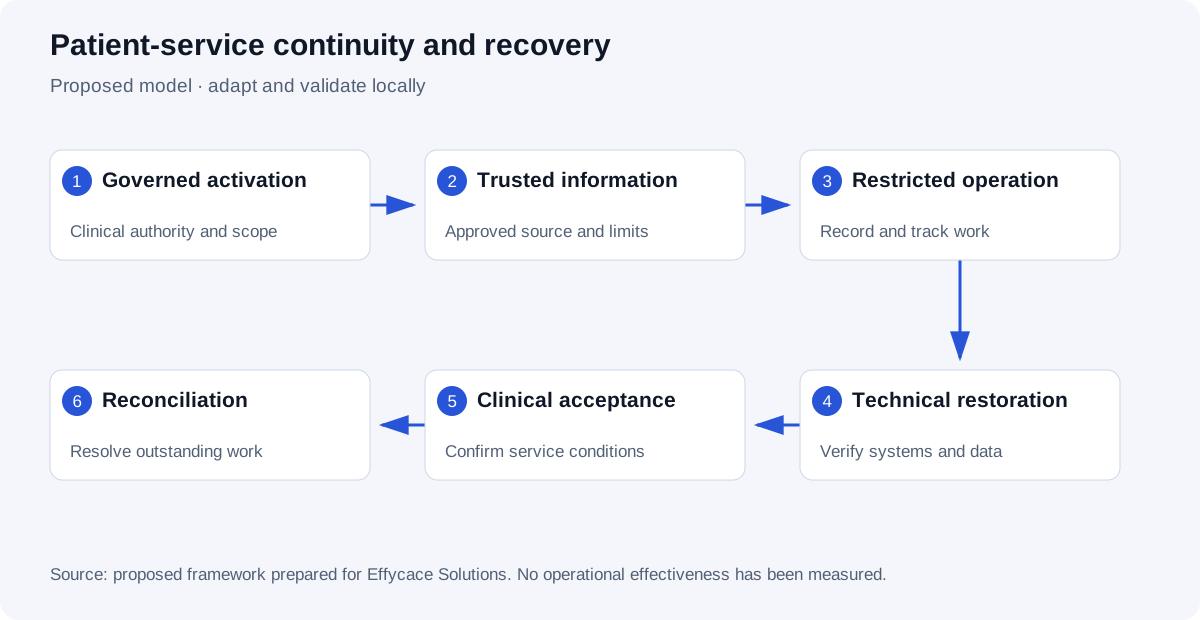
Source: proposed model prepared for Effycace Solutions. This diagram represents analytical relationships and proposed workflow, not observations or measured effectiveness. A textual description is embedded in the downloadable SVG.
Framework component 2
Establish accountable identity and access
Proposed · requires local validation
The proposed access model distinguishes ordinary clinical use, administration, vendor support and emergency access. Each requires a purpose and an accountable owner. Where technical limitations prevent an intended control, document the limitation and a reviewed compensating arrangement.
An access review should establish who has an account, why they need it and which systems or information they can reach. Include temporary personnel and external support. Link joiner, role-change and departure processes to actual revocation, with evidence that changes reached the affected applications.
For privileged and remote access, review the authentication method, approval, session scope and ability to revoke access. A support arrangement should identify the individual or accountable organisation operating it. A confidentiality agreement does not, by itself, restrict technical access.
Emergency access deserves a specific test. Staff should know how to request it when normal processes are unavailable, who authorises its use and how it will be reviewed afterwards. Protect emergency credentials and avoid creating an unrestricted shared route that becomes routine. The clinical urgency does not eliminate the need to establish accountability.
A useful initial assurance exercise is to select one departed staff account and one completed vendor support engagement, then verify the relevant access was actually removed. Use authorised records and protect staff information during the review.
Framework component 3
Treat patient information as a dependency with trust conditions
Proposed · requires local validation
List the essential information for each pathway and its source. Record where copies exist, which copies may be used during downtime and how their currency will be communicated. The clinical owner should identify what limitations require escalation or restriction.
Availability and integrity require separate questions. Can staff obtain the information? Is the source believed to be complete and accurate? If there is uncertainty, who decides whether it can support the service? A reachable system should not automatically be treated as a trusted record after a suspected compromise.
Minimise uncontrolled copying. A proposed downtime process should specify the information needed for its purpose, authorised access, secure handling, storage and reconciliation. Broad routine exports can create confidentiality and retention problems without providing a workable service fallback.
Keep a register of material data flows, including external partners and hosted services. For each flow, identify the sending and receiving owners, expected acknowledgement and handling of failures. This is particularly useful when an application interface can fail without a complete platform outage.
Framework component 4
Make supplier responsibilities explicit
Proposed · requires local validation
Outsourced IT and hosted applications can support resilience, but the division of responsibility must be understood. Ask the provider to identify which recovery tasks it performs and which remain with the clinic. Include configurations, integration dependencies, administrative access and data retrieval.
A supplier's platform recovery claim should be accompanied by its scope and assumptions. Does it cover the service the clinic uses? Was a comparable configuration tested? What must the clinic provide before recovery can begin? An answer based only on a generic service description may leave material work unassigned.
Agree an incident coordination route that remains usable if normal email or the primary application is unavailable. Record how the clinic authenticates the provider's personnel and how the provider authenticates the clinic's recovery request. Store essential contacts and instructions where they remain accessible during the chosen disruption scenario.
For a group, clarify whether the central office or each site coordinates with suppliers. Both parties should know who may approve recovery actions and how local service impacts are reported. Conflicting instructions during an incident can delay restoration or introduce unsafe assumptions.
Framework component 5
Design downtime operations under clinical governance
Proposed · requires local validation
The proposed downtime plan should contain activation criteria, an accountable incident lead and a clinically approved service boundary. It should specify how staff communicate the current operating state and how restrictions are updated.
Define the records created during downtime. For each, establish identification, author, time, secure custody, handover and later reconciliation. Include a way to track outstanding work. The record format is only one component; ownership of the resulting work is equally important.
Assess capacity explicitly. A manual process may require more staff time, reduce throughput or create a growing backlog. The operational lead should determine whether that process can be sustained under the exercise conditions, while clinical leadership determines its acceptable use.
Prepare patient and partner communications that explain service availability accurately without disclosing sensitive information. Keep statements about the incident separate from confirmed facts about service operation. An alternative channel should be approved and accessible before the normal one fails.
Framework component 6
Build recovery around a trusted service
Proposed · requires local validation
The recovery plan should distinguish restoring infrastructure, restoring applications and confirming that a patient pathway works. Each stage requires an owner and acceptance evidence. Make the dependence on identity, connectivity, configuration and external interfaces visible.
For every selected service, define the desired recovery time and tolerable loss of recorded information, then examine whether the design can support them. These are objectives until tested. The actual exercise result should record elapsed time and the recovery point achieved, together with any reconstruction needed.
Protect recovery resources under the assumed incident. If the plan depends on a compromised administrator account, an inaccessible knowledge base or unavailable encryption keys, the backup copy may not be enough. Test access to recovery resources as part of the exercise rather than assuming they will be reachable.
Before returning to normal operation, obtain technical validation and clinical workflow acceptance. A technical team can establish application availability and perform relevant integrity checks. The service owner must assess whether the workflow and information conditions support the intended clinical service.
Framework component 7
Plan reconciliation before the outage
Proposed · requires local validation
Reconciliation closes the gap between downtime records and restored systems. Assign who enters or verifies records, how duplicate entries are detected and how uncertain status is escalated. The plan should address unresolved work, rather than treating successful data entry as the end of recovery.
Consider a hypothetical outpatient service that records requests on approved downtime forms. After restoration, some requests may already have been communicated through another channel. The process needs an agreed way to establish their status before generating duplicate work. This is a workflow design question for clinical and operational owners, not a product-specific recommendation.
Record the reconciliation backlog and how long it takes to resolve. If normal appointments resume while staff still manage significant recovery work, capacity planning should reflect that demand. A system uptime measure cannot show the whole service impact.
Framework component 8
Exercise without overstating assurance
Proposed · requires local validation
The proposed exercise programme uses progressively stronger evidence. A tabletop tests decisions and coordination. A process walkthrough tests whether staff can use the plan. A technical restoration test examines systems. A service exercise connects the restored technology to approved workflow and handoffs.
Label each result accordingly. Completing a tabletop does not establish recovery performance. A technical test with synthetic information can establish useful system behaviour, but it does not establish all aspects of a real clinical event. Testing limits belong in the report to management.
Use an authorised non-production setting where appropriate, synthetic patient information and agreed stop conditions. Protect live care and avoid active testing of clinical equipment without a specifically approved plan. The exercise lead should be able to pause the activity if its safety assumptions no longer hold.
The following proposed acceptance criteria need local agreement:
| Area | Example acceptance question |
|---|---|
| Authority | Can participants identify who may activate and change the operating state? |
| Information | Can staff explain the approved source and its limitations? |
| Workflow | Can the tested activity be completed within its approved boundary? |
| Coordination | Do local and external participants receive and acknowledge essential messages? |
| Restoration | Are technology and service checks completed before resumption? |
| Reconciliation | Is outstanding work assigned and demonstrably resolved? |
Framework component 9
Incident coordination and regulatory assessment
Proposed · requires local validation
Run service continuity, technical investigation and data-breach assessment as connected workstreams. They may progress at different speeds. A clinic may restore a service while still investigating whether information was accessed or changed.
Maintain a decision log recording known facts, assumptions, authorisations and changes in the operating state. Store and share it through approved channels with access appropriate to its contents. Identify who coordinates with external responders, insurers or relevant authorities where applicable.
Do not rely on a single generic reporting timer copied from a publication. The provider's responsible team must identify the applicable regime, trigger, recipient and current deadline. The official HIA page's statement on commencement is material to that assessment; future requirements should not be confused with obligations already in force.
Framework component 10
Governance and implementation
Proposed · requires local validation
The executive sponsor funds remediation and resolves cross-site priorities. Clinical leadership approves service boundaries and clinical acceptance. Operations coordinates staffing, resources and handoffs. Technology and suppliers provide implementation and recovery evidence. The data protection function assesses information handling and applicable breach duties.
Smaller providers may combine roles, but they should retain the decisions those roles represent. An outsourced IT provider cannot take ownership of a clinic's clinical operating boundary simply because it manages the application.
Begin with one pathway over 90 days. During the first month, map dependencies and access responsibilities. During the second, resolve material ownership gaps and prepare the downtime and recovery exercise. During the third, run the exercise, document limitations and assign improvements. Expand to other pathways using lessons from the pilot.
Framework component 11
Report evidence executives can use
Proposed · requires local validation
Management should see which pathways have been examined, what type of exercise was completed and where the service remains dependent on untested assumptions. Report material unresolved access issues, missing recovery resources and overdue corrective work with clear owners.
Keep measures connected to their scope. “Three sites completed a registration walkthrough” is useful when accurately stated. “The group is ransomware ready” is a much broader claim that the exercise may not support. Include the capacity, duration and conditions actually demonstrated.
When a target is not met, present choices: improve the design, change the service fallback, arrange partner support or revise an accepted objective through the appropriate governance. The exercise has succeeded as an assurance activity if it reveals a meaningful decision before an actual incident.
Framework component 12
A service readiness worksheet
Proposed · requires local validation
Use the following proposed worksheet for the selected pathway. Complete it jointly with clinical, operational and technology representatives. Its purpose is to expose decisions and missing evidence, rather than to produce a single readiness score.
| Worksheet item | Entry needed before acceptance |
|---|---|
| Disruption scenario | Which application, information source or identity function is unavailable or under investigation? |
| Clinical authority | Who determines the activities that may continue and the restrictions that apply? |
| Activation | What observation triggers the plan, and who communicates the change? |
| Information boundary | Which sources may be used, how current are they and what is missing? |
| Operating capacity | Which activities and workload were demonstrated under the exercise conditions? |
| Outstanding work | How is work tracked, handed over and escalated? |
| Resumption | Which technical and clinical checks are needed before normal operation? |
| Reconciliation | Who resolves downtime records, uncertain status and duplicates? |
| Remaining gaps | What is untested, who owns it and when will it be reviewed? |
Record the version of the plan used in the exercise. If staff relied on an unofficial note or an experienced colleague's memory, identify the missing instruction. That finding can be addressed through procedure design and training without implying that an individual caused the weakness.
Framework component 13
Use different scenarios to challenge different assumptions
Proposed · requires local validation
A complete application outage primarily tests availability and fallback coordination. Loss of the usual sign-in service tests whether recovery and approved emergency access depend on the same unavailable identity system. A suspected data integrity issue tests how staff establish trust and communicate information limitations.
Do not combine every difficulty into the first exercise. Begin with a bounded scenario, understand the result and add complexity deliberately. A technically demanding exercise can produce less useful evidence if participants cannot distinguish the original problem from unrelated failures introduced by the test.
For a healthcare group, a later exercise might examine coordination across two sites with different local resources. One site's readiness should not be inferred from another's result. Capture which parts of the process are common and which require local variation.
Framework component 14
Translate findings into funded decisions
Proposed · requires local validation
Prioritise improvements according to their effect on the approved patient service and the uncertainty they resolve. An inaccessible contact list may need a straightforward process correction. A recovery design that cannot provide essential information may require architectural work or a revised service contingency.
For each proposed investment, state the capability it should create and how it will be tested. A new backup service might improve recovery resources, but management should still require a service exercise to establish the resulting patient-workflow capability. Additional forms might improve recording, but they need an approved reconciliation process.
Where improvement cannot be completed promptly, document the interim service boundary and its acceptance by the appropriate clinical and executive owners. Set a review date tied to the remaining exposure. Avoid closing a finding solely because funding has been requested or a product purchased.
5Implementation and validation
Recommendations are ordered by priority. Effort is a broad estimate for a mid-sized organisation; your own will depend on what is already in place.
| # | Recommendation | Owner | Priority | Effort | Framework reference |
|---|---|---|---|---|---|
| 1 | Select a patient pathway and identify its essential information and digital dependencies. | Clinical sponsor with operations | High | Medium | MOH CS/DS Essentials A.13; NHS recovery standard |
| 2 | Approve downtime activities, restrictions and escalation under clinical governance. | Clinical governance lead | High | Medium | Proposed service-continuity practice |
| 3 | Exercise activation, restricted operation and reconciliation with synthetic information. | Operations and technology leads | High | Medium | NHS recovery standard |
| 4 | Recheck current obligations and HIA commencement before publishing a reporting procedure. | Data protection and regulatory lead | High | Low | MOH CS/DS information page |
The executive sponsor funds remediation and resolves cross-site priorities. Clinical leadership approves service boundaries and clinical acceptance. Operations coordinates staffing, resources and handoffs. Technology and suppliers provide implementation and recovery evidence. The data protection function assesses information handling and applicable breach duties.
Smaller providers may combine roles, but they should retain the decisions those roles represent. An outsourced IT provider cannot take ownership of a clinic's clinical operating boundary simply because it manages the application.
Begin with one pathway over 90 days. During the first month, map dependencies and access responsibilities. During the second, resolve material ownership gaps and prepare the downtime and recovery exercise. During the third, run the exercise, document limitations and assign improvements. Expand to other pathways using lessons from the pilot.
| Action | Completion evidence |
|---|---|
| Select a patient pathway and identify its essential information and digital dependencies. | Pathway map and approved information requirements. |
| Approve downtime activities, restrictions and escalation under clinical governance. | Documented clinical operating boundary. |
| Exercise activation, restricted operation and reconciliation with synthetic information. | Observed capacity, timings and unresolved work. |
| Recheck current obligations and HIA commencement before publishing a reporting procedure. | Dated applicability record; future and current duties distinguished. |
Download the assessment worksheet (CSV) · Download the framework diagram (SVG) · Download the source register (JSON)
Companion report: Can patient services continue during a cyber incident?.
6Limitations
- This paper synthesises the three primary sources cited in section 1 and offers original proposed operating practices. No patient information, staff records, contracts or clinical devices were inspected. No clinical efficacy, recovery time, compliance outcome or incident reduction was measured. The scenario is hypothetical.
- The framework requires adaptation to service type, operating scale, technology and clinical governance. It does not establish the appropriateness of any particular medical decision or downtime procedure. Clinical procedures require approval by the provider’s authorised clinical leadership, with technical and regulatory validation before operational use.
- The framework has not been independently peer reviewed or empirically validated. Regulatory references reflect sources checked on 11 November 2026 and may change; readers must determine current applicability.
7How to use this whitepaper
Design principles are proposed practices, not measured findings. Confidence concerns the support for an analytical judgement, not a numerical probability of an incident. No likelihood estimates are made. Hypothetical examples and conceptual diagrams do not establish prevalence or effectiveness. References describe source guidance; worksheets and implementation steps are proposed tools.
- High confidence
- Based on good-quality information from several independent sources, or on a complete dataset. A high-confidence judgement can still be wrong.
- Moderate confidence
- Based on credible information, but with gaps, a limited sample or more than one plausible interpretation.
- Low confidence
- Based on scarce, fragmented or single-source information. Treat it as something to watch, not as the sole basis for a major decision.
8References
- Ministry of Health, Singapore. Cybersecurity and Data Security Essentials. Reviewed 11 November 2026. https://isomer-user-content.by.gov.sg/377/57d4f255-0798-43fe-9737-0ea708953cf7/CYBERSECURITY_AND_DATA_SECURITY_ESSENTIALS.pdf
- Ministry of Health, Singapore. About Cybersecurity and Data Security. Reviewed 11 November 2026. https://www.healthinfo.gov.sg/csds/
- NHS England. (2026). Disaster recovery and business continuity. Infrastructure hosting standards for the NHS. https://digital.nhs.uk/services/cloud-centre-of-excellence/infrastructure-centre-of-excellence/standards-policy-and-architecture/infrastructure-hosting-standards-for-the-nhs/disaster-recovery-and-business-continuity
9About this whitepaper
- Author
- Fahad Imran, Effycace Solutions
- Funding and interests
- Published by Effycace Solutions with Fahad Imran as author. Prepared using AI-assisted research and drafting from the cited public sources. No client information was used. No independent peer review or operational evaluation was conducted.
- Distribution
- TLP:CLEAR This report may be shared freely, with attribution.
- Corrections
- If you find an error, write to contact@effycace.com. Corrections are recorded in the version history below.
How to cite
Fahad Imran (2026). Cyber resilience for clinics and healthcare groups (Report EFF-WP-2026-002, version 1.0). Effycace Solutions Pte Ltd. https://www.effycace.com/research/reports/healthcare-cyber-resilience-clinics-whitepaper/
Version history
| Version | Date | Change |
|---|---|---|
| 0.9 | 11 November 2026 | Integrated editorial draft with source register, conceptual diagram and assessment worksheet. Not published. |
| 1.0 | 12 November 2026 | First publication edition, with author attribution, explicit review limitations and supporting assessment materials. |
This report is general information, not advice for your specific circumstances. See our Terms of Use.